
Spring Revolution – Mizzima Daily Notes

10 September 2026
Myanmar’s situation on 9 September was shaped by the military’s intensifying recruitment drive in Yangon, continuing civilian harm from the conflict, and revolutionary forces’ growing political coordination toward federal democratic governance. At the same time, Myanmar’s crisis continued to draw attention at the United Nations and among international investigative bodies.
Revolutionary Politics and Military Developments
The tightening of military recruitment in Yangon indicates that the junta’s manpower needs are becoming increasingly urgent. According to the Rangoon Scout Network (RSN), more than 70 men were recruited within two weeks, from the last week of August to the first week of September, for the upcoming Batch 28 military training. The actual number of those detained and forcibly recruited on the ground could be even higher.
Particularly notable is that arrests and recruitment, which previously occurred mainly at night, are now increasingly taking place during the daytime. This indicates growing pressure on urban residents as the military attempts to meet its conscription targets.
At the same time, political organization among revolutionary forces is also advancing. At a meeting of the Steering Council for the Emergence of a Federal Democratic Union (SCEF) on 8 September, the Sagaing Federal Unit, Mandalay Region and Magway Federal Unit were formally accepted as new members. This development reflects continuing efforts by revolutionary forces to build federal democratic governance structures politically, even as armed conflict continues across the country.
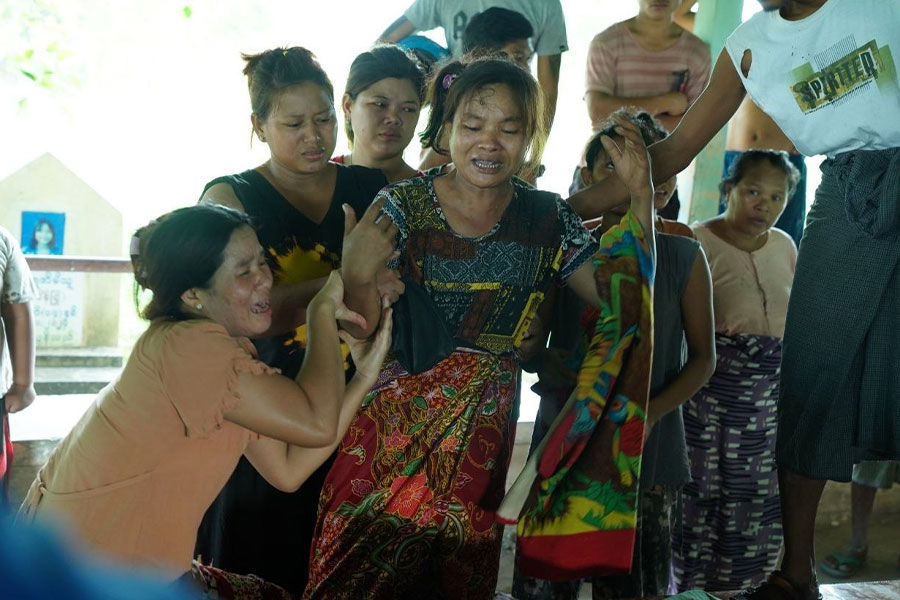
On the ground, however, civilians continue to suffer the consequences of the fighting. In a village in Kale Township, Sagaing Region, a Grade 8 student aged around 16 was killed on 6 September after stepping on a landmine while going fishing. Landmines and explosive remnants of war therefore remain a serious threat not only in active conflict zones but also during the ordinary daily activities of civilians.
International investigative bodies are also continuing to highlight the growing number of civilian casualties and possible international crimes in Myanmar. Nicholas Koumjian, head of the Independent Investigative Mechanism for Myanmar (IIMM), has said that the military is increasingly relying on airstrikes, with civilians bearing the main consequences.
Domestic Social and Human Rights Situation
The humanitarian and human rights consequences of Myanmar’s political crisis remain visible at the international level. While forced recruitment and military pressure continue, repression also remains a concern for people involved in political, social and policy-related activities.
The birthday of Min Zin, co-founder and executive director of the Institute for Strategy and Policy — Myanmar (ISP-Myanmar), fell on 9 September. This year, however, he spent his birthday separated from his family, friends and colleagues while being detained in China. His situation also reflects the pressures faced by individuals involved in research, policy work and public discussion related to Myanmar.
Economy, Technology and Environment
Although not directly related to Myanmar’s political crisis, global technological developments and natural disasters are increasingly affecting social and economic conditions in Myanmar.
In the technology sector, Elon Musk has predicted that there could be at least one billion humanoid robots within the next decade and that their productivity could eventually exceed that of human workers.
China has also issued new regulations governing exit and entry administration. The regulations were announced on 31 July and are due to take effect on 15 September. Such regulatory changes could also affect cross-border movement in the region, including Myanmar, which shares a long border with China.
In Japan, meanwhile, emergency rescue operations were launched following heavy rainfall in the central city of Nagoya, as severe extreme-weather events and urban flooding remain an important challenge across Asia.
Thailand and the Region
Thailand’s Meteorological Department has issued its fifth weather warning, forecasting heavy to very heavy rainfall from 9 to 13 September. Northern, northeastern, central and eastern Thailand were expected to experience particularly heavy rainfall, with risks of flash floods and runoff.
In Bang Lamung district of Chonburi Province, a woman was shot dead at a kindergarten, and police are investigating whether her husband, a police officer, was involved.
Thailand’s public broadcaster Thai PBS has also received two awards at the 2026 AsiaVision Awards, presented by the Asia-Pacific Broadcasting Union (ABU), recognizing the quality of news reporting and television production by media organizations in the region.
Elsewhere in the region, Bangladeshi police raided a hotel in Cox’s Bazar and arrested six people suspected of involvement in what authorities believe may be one of the country’s largest organized cyber-scam operations.
International Developments
Myanmar continued to feature prominently at the United Nations. The opening and first plenary meeting of the 81st Session of the United Nations General Assembly was held at UN Headquarters in New York on 8 September, and Myanmar’s delegation, led by Permanent Representative Ambassador Kyaw Moe Tun, attended the session. At the same time, continued reporting and documentation by the IIMM on possible international crimes in Myanmar demonstrates that international attention to accountability and justice remains significant.
In the wider Asian region, tensions between China and the Philippines over the South China Sea also continue. At the Seoul Defense Dialogue in South Korea, Philippine Defense Secretary Gilberto Teodoro strongly criticized China’s position in public remarks.
In the Middle East, the underlying causes of the Israeli-Palestinian conflict remain unresolved, while violence continues to escalate in the West Bank. The expansion of Israeli settlements, intensified military operations since 2023, and responses by Palestinian armed groups have further complicated the situation.
In Pakistan’s northern border areas, police stations are installing reinforced protective netting to defend against militant drone attacks, reflecting how tactics associated with the war in Ukraine are increasingly being adapted by security forces in other parts of the world.
Meanwhile, in India’s Karnataka State, a forest officer was injured while attempting to rescue a wounded leopard, highlighting the risks associated with human-wildlife interaction and wildlife conservation work.
In sport, Saudi Pro League players Sadio Mané and Julián Quiñones have been included among the nominees for the 2026 Ballon d’Or, while goalkeepers Yassine Bounou and Édouard Mendy have also been shortlisted for the annual best goalkeeper award – reflecting the increasingly prominent role of leagues outside Europe in global football.
Assessment
Taken together, 9 September’s developments show the Myanmar military regime pushing harder to replenish its manpower even as military pressure on civilians continues, while revolutionary forces press ahead politically on building federal democratic governance. Amid this, civilians continue to face the consequences of forced recruitment, landmines and airstrikes. At the same time, Myanmar’s situation remains under sustained attention from the UN and international investigative mechanisms, even as the wider region grapples with its own weather disasters, cyber-crime, security tensions and cross-border challenges, underscoring that Myanmar’s crisis cannot be viewed in isolation from humanitarian, regional-security and international-justice concerns.


Comments