
Myitsone Dam Fantasy, EV Pipe Dreams, and More
- Jul 3
- 4 min read
Myanmar regime insists Myitsone Dam’s benefits outweigh risks

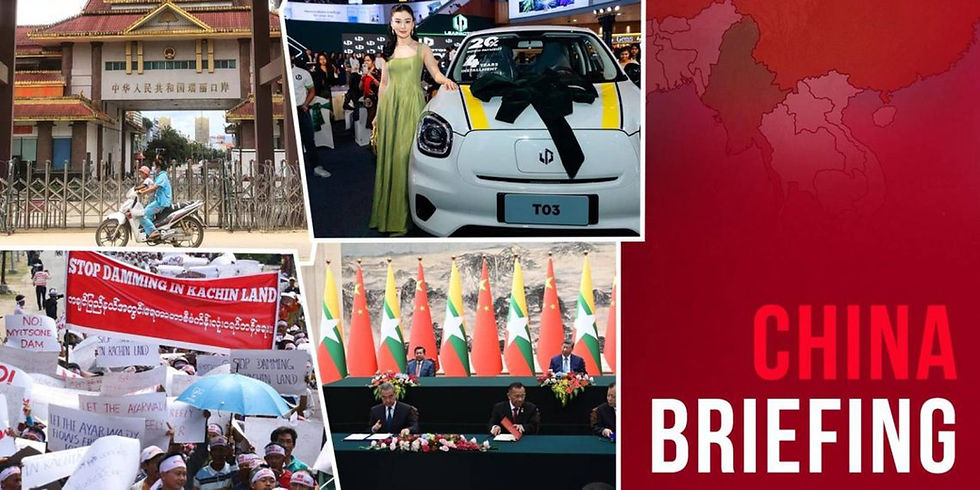
Myanmar’s junta is pressing ahead with the revival of the long‑suspended Myitsone Dam project, with presidential office spokeswoman Khaing Khaing Soe declaring this week that the China‑backed project offers “many benefits and only minor drawbacks.”
She confirmed the dam’s resumption was discussed during Min Aung Hlaing’s recent trip to Beijing, portraying it as the key to solving the country’s crippling energy crisis and achieving nationwide electrification.
The project’s suspension in 2011 after mass protests angered China, which expected to import 90 percent of its 6‑gigawatt output. But resentment of Beijing’s deep influence and fears of flooding an area the size of Singapore prevailed. Now, the military regime’s growing dependency on Beijing gives new urgency to reviving the project.
Kachin State Chief Minister Khet Htein Nam has emerged as the regime’s frontman here. Once a critic, the ethnic Kachin politician now swears the dam can be completed within eight‑and‑a‑half years, helping Myanmar meet its target of 100 percent electrification by 2030. At a June 23 meeting with locals, he claimed China is now ready to tackle environmental issues with new technology, monitoring the dam 24/7. More than 20 public meetings have been held across regime-controlled areas in Kachin since January to solicit local support, but civil society groups and the Kachin Independence Army (KIA) continue to reject the project.
EV pipe dreams tie Myanmar to China

Myanmar’s military regime has announced ambitious plans for electric cars that would entrench dictator Min Aung Hlaing’s family business interests and lock the country more tightly into China’s industrial orbit. The regime has set targets for EVs to make up 32 percent of vehicles by 2030, 67 percent by 2040, and 100 percent by 2050, according to Commerce Minister Tun Ohn.
Tun Ohn told Chinese business representatives in Shanghai during Min Aung Hlaing’s June visit that 99 percent of EVs already imported into Myanmar come from China, including buses and taxis. However, numbers are estimated in the tens rather than hundreds of thousands.
Min Aung Hlaing himself has called for increased investment in the EV sector, particularly from Chinese manufacturers, while highlighting solar power as a priority area for cooperation. He has even touted EV manufacture in Myanmar.
EVs are exempt from an odd-even driving ban on alternate days that was declared amid the fuel crisis caused by the U.S.’ war on Iran. The policy has triggered a surge in demand for Chinese‑made EVs, with companies owned by Min Aung Hlaing’s children—Aung Pyae Sone and Khin Thiri Thet Mon—emerging as dominant importers and distributors. And since the regime is unable to supply electricity for much of the day, their solar panel businesses are also thriving.
Muse–Kyaukphyu railway good to go—but for ground realities

On June 30, Khaing Khaing Soe also announced that feasibility studies for the Muse–Mandalay segment of the China‑backed Muse–Kyaukphyu railway have been completed, and preliminary route selection for the Mandalay–Kyaukphyu leg is also finished.
The railway is part of the China-Myanmar Economic Corridor (CMEC), a Belt and Road (BRI) initiative that is supposed to link China’s landlocked Yunnan to the Indian Ocean through Myanmar.
Khaing Khaing Soe admitted that ongoing conflict has forced work to halt in some areas due to security concerns but vowed the regime is ready to resume it “as soon as conditions improve.”
The same day, a new BRI Implementation Working Committee convened in Naypyitaw with representatives from 23 ministries and other agencies. During Min Aung Hlaing’s Beijing trip, the two sides agreed to accelerate the CMEC and restart stalled projects including the Kyaukphyu deep-sea port and the Mandalay–Muse Railway.
At the Muse end, although fighting has paused following Beijing’s intervention, key border trade routes remain under the control of the Myanmar National Democratic Alliance Army (MNDAA), while further south the planned railroad would pass through swathes of territory held by resistance forces.
Commerce Minister Tun Ohn told Chinese businesspeople in Shanghai that he expects the Kyaukphyu deep-sea port, also stalled by fighting in Rakhine, will “soon” enter its implementation phase. Chinese leaders, Khaing Khaing Soe added, pledged to “fully cooperate” with Myanmar in pursuit of permanent peace, border stability, and implementing security measures so that the projects can proceed.
Myanmar stands alone in implementing all four of Xi’s Global Initiatives

Myanmar has become the only country to sign memorandums of understanding on all four of Chinese President Xi Jinping’s so-called Global Initiatives—on security, development, civilization, and governance.
At a June 30 press briefing, presidential spokeswoman Khaing Khaing Soe said while other countries have signed MoUs on one or two of these initiatives, Myanmar alone has committed to all four, signaling “complete alignment” with Beijing’s global agenda.
The MoUs were signed during putschist president Min Aung Hlaing’s visit to China in June. While China portrays the initiatives as having the “international public good” at heart, Western critics argue they operate as a coordinated framework boosting authoritarian regimes under the guise of non‑interference, channeling development aid to extend China’s reach, promoting cultural narratives that legitimize authoritarian rule, and reshaping global institutions to weaken Western leadership.
Going the extra mile in demonstrating loyalty, Myanmar’s regime has also joined two international “groups of friends” of Xi’s initiatives: the Group of Friends of the Global Development Initiative, and the Group of Friends of the Global Governance Initiative.


Comments