
Myanmar’s Spies: A History of Surveillance, Power and Purges
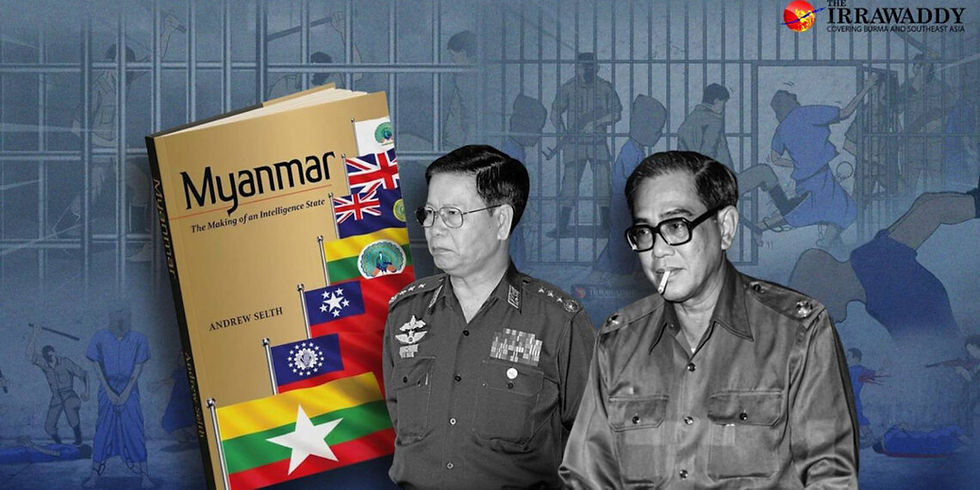
Myanmar: The Making of an Intelligence State
By Andrew Selth
ISEAS Publishing, Singapore, 2026
609 pp. US$48
This book is bound to become a classic. Never before has any international scholar described and analyzed the history of intelligence in Myanmar, from the days of the kings, through colonial rule, to democratic and military-dominated governments after independence. And no one would be more qualified to do this study than Andrew Selth, an Australian academic and former diplomat who has written extensively about Myanmar for several decades. The Burmese kings sent spies across the eastern as well as western borders before invading armies captured the old Siamese capital Ayutthaya and the old Arakan kingdom. And they developed what a British historian, quoted by Selth, has described as “a powerful and sophisticated internal espionage system” when the country was threatened by European colonial powers.
A new, entirely different intelligence apparatus emerged after the British conquest in the 19th century. In 1896, a Criminal Intelligence Bureau was formed within the headquarters of the Burma Police, and its duty was quite specific: to monitor domestic dissent and “deal with cases of a political nature.” A Special Branch of the police continued that work throughout the colonial era, and its work became especially important after the Saya San rebellion in the 1930s, which also prompted the British to send in military police officers from India.
In the years after Myanmar’s independence in 1948, Selth outlines how the new government created five main intelligence agencies, of which the Military Intelligence Service (MIS) became the most powerful, and even cooperated with foreign intelligence services. Some officers were trained by the British, and then chiefly to spy on Myanmar’s growing communist movement. The CIA also provided training on the US-held island of Saipan in the Pacific. Among those receiving instruction was “Spectacles Tin Oo,” who became a close associate of the dictator General Ne Win and, as such, one of the most feared men in the country. He collected intelligence not only on political dissidents but also, and perhaps primarily, on officers and the ranks of the military, on whose loyalty the Ne Win regime relied for its survival.
Tin Oo (not to be confused with General Tin Oo, one of the founders of the National League for Democracy) and his inner circle of followers eventually became too powerful, acting like a state within a state, which led to his downfall in July 1983 and a purge of the entire intelligence apparatus. The near vacuum that ensued has been seen as the reason why North Korean agents managed to infiltrate Yangon and, in October that year, detonate a bomb that killed 17 visiting South Korean officials and four Myanmar nationals.
With MI Tin Oo behind bars, Ne Win needed a new officer who could rebuild the country’s intelligence services, and that was his trusted protégé, Khin Nyunt. His Directorate of Defense Services Intelligence (DDSI) soon had agents all over the country, and surveillance—and repression—of the population at large became of utmost importance during and after the 1988 pro-democracy uprising. According to Selth: “The DDSI already was the largest and most powerful intelligence agency in Myanmar before 1988, but under the SLORC [the State Law and Order Restoration Council] it dramatically increased in size, sophistication and territorial presence. The refashioning of the SLORC into the State Peace and Development Council in 1997, possibly on the advice of an American public relations consultant, does not seem to have resulted in any significant changes to the intelligence structures and procedures that were set in train after the uprising.”
Selth provides detailed descriptions of how Khin Nyunt’s DDSI and its affiliated agencies were structured, and how they operated. Now, foreigners, among them diplomats and others who were suspected of having contacts with the pro-democracy movement, also became targets of its surveillance. But like MI Tin Oo before him, Khin Nyunt grew too powerful for comfort, and he was eventually ousted in October 2004 along with almost his entire intelligence apparatus. New intelligence outfits had to be created, and those were placed more directly under military command to avoid a repeat of what happened in 1983 and 2004.
During Burma’s decade of relative openness, from 2011 to 2021, the intelligence services remained wholly autonomous from the governments in Naypyitaw, and that separation became even more obvious during the years when the NLD—after an election in 2015—was allowed to appoint most ministers. I experienced this firsthand when I visited the country on many occasions between 2012 and 2019. I was under constant surveillance, and the intelligence agents often didn’t even bother to hide it.
Selth also describes how various opposition forces have treated suspected informants for the various intelligence services. In 1992, the All-Burma Students’ Democratic Front’s section in Kachin State killed 15 of their own comrades on suspicion of being spies. In 2021, 25 unarmed prisoners were executed by Karen rebels. In both cases, the opposition groups had depended on faulty intelligence, which their own agencies had provided.
Anyone who wants to understand how successive military-dominated governments have survived, and on what traditions Myanmar’s intelligence services were built, has to read this book. It contains a 43-page bibliography, which is the most extensive I have seen in any book about Myanmar. The book also lists, for the first time, military intelligence chiefs since 1959, regional military commands in 2024, and the various intelligence agencies that shaped today’s Myanmar. Its subtitle, “The Making of an Intelligence State,” could not be more appropriate.


Comments