
China and India Must Act Against Myanmar Junta’s Air Terror in Arakan

The Myanmar military’s latest air attack on Kyauktaw’s Indian Market, which reportedly killed 50 civilians and injured around 60 others, has shocked the international community. The attack became headline news across major international media outlets. At least 30 well-known media organizations, including Reuters, The Washington Post, and The New York Times, reported on the incident, describing it as one of the most horrifying attacks in Myanmar’s ongoing conflict. The United Kingdom, European Union, United Nations officials, and other international actors have also condemned the killing.
But international reporting and condemnation alone have clearly failed to stop the Myanmar junta. Statements may expose the crimes, but they have not prevented the generals from carrying out more attacks. Since the Kyauktaw market massacre, Myanmar military aircraft have continued to attack civilian areas in several parts of Arakan, including Kyauktaw, Rathedaung, Thandwe, Pauktaw, and Ponnagyun. More civilians have been killed and injured, while civilian property has continued to be destroyed.\
This raises a simple but serious question: What can actually stop the Myanmar junta from terrorizing civilians?
China and India can play an important role.
First, there is a clear moral responsibility. China and India are Myanmar’s two major neighbors. Both countries have recently hosted Myanmar junta leaders, and such high-level visits may have been understood by the generals as a sign that powerful regional neighbors will continue to engage with them despite their military actions. If the junta believes that it has strong regional backing, it may become even more confident in continuing its attacks.
China and India also present themselves as responsible and law-abiding powers on the international stage. They therefore cannot simply remain silent while civilians are being killed by airstrikes in areas close to their own borders and strategic interests. Their influence gives them an opportunity—and a responsibility—to send a clear message that attacks on civilians cannot continue without consequences.
Second, both countries have strong strategic interests in Arakan. China has major investments in the region, including oil and gas pipelines, a deep-sea port, and a planned economic zone. India is also implementing the Kaladan project, which connects its northeastern region with the Bay of Bengal through Arakan. These are not small or temporary interests. They are important long-term connectivity and economic projects.
For these projects to succeed, stability and security are essential. The ULA-led Arakkha administration has welcomed these economic and connectivity projects. However, the Myanmar junta’s expanding air campaign is creating an increasingly hostile and unstable environment around the areas connected to them.
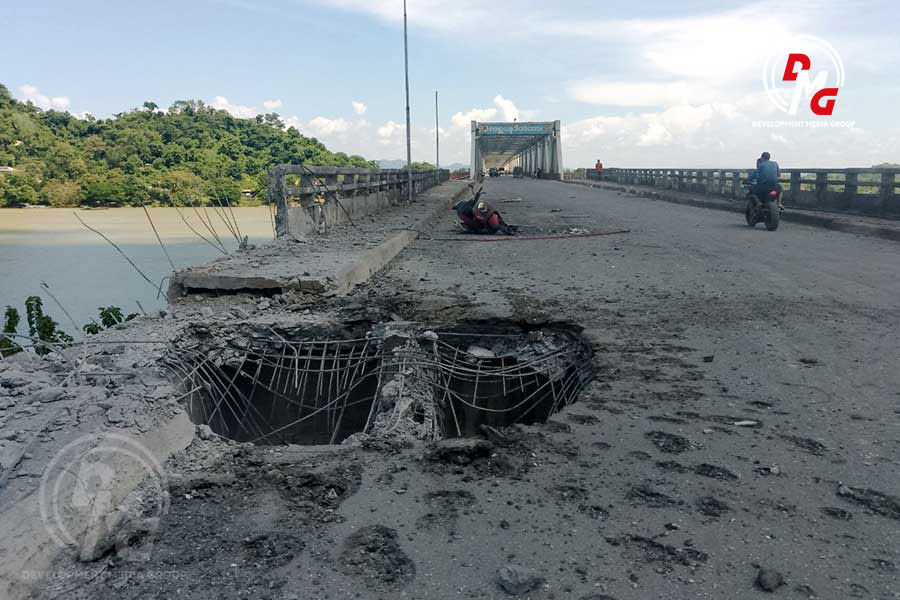
The pattern is already visible. In 2026, junta airstrikes have increasingly killed and injured civilians and destroyed civilian property in townships connected to major Chinese and Indian projects. Kyauktaw and Paletwa are important to the Indian Kaladan project, while Kyaukphyu and Rambree are closely linked to China’s economic interests. If air attacks continue in these areas, local communities may increasingly associate foreign projects with insecurity and conflict, even when those projects themselves are not responsible for the violence.
This could become a serious problem for both China and India.
Therefore, their interests are not only economic. They are also about long-term stability and public trust. China and India should use their influence to make clear to the Myanmar junta that continued air attacks against civilians are unacceptable.
Silence may be interpreted as acceptance. If China and India want their projects in Arakan to have a stable future, they should not wait until the damage becomes irreversible. They should speak—and, more importantly, act—to help stop the junta’s air terror against civilians.


Comments