
Spring Revolution – Mizzima Daily Notes

30 October 2026
Despite navigating severe hardships following the military coup, the determination of Myanmar’s people for democracy and the eradication of military dictatorship remains unwavering, as efforts continue across international diplomacy, military affairs, and public resistance. Meanwhile, the military junta’s violent column offensives, border-related crises, and the geopolitical impacts of the international arena have become increasingly prominent.
Domestic Military Affairs, IDP Crises, and Human Rights Violations by the Military Junta
In Pauk Township, Magway Region, more than 5,300 local residents from villages such as Thapyay Yay, Chet Kan, Hman Htaung Kwin IDP camp, Wan Lal Yoe Upper, Taepin Kan, and Pe Hnit Pin have been displaced due to military columns advancing into the area, according to the Pauk Township Department of Social Affairs, Labor, and Humanitarian Affairs. It is assessed that the military column may be marching to deliver rations to Defense Products Industry (KAPASU) 24.
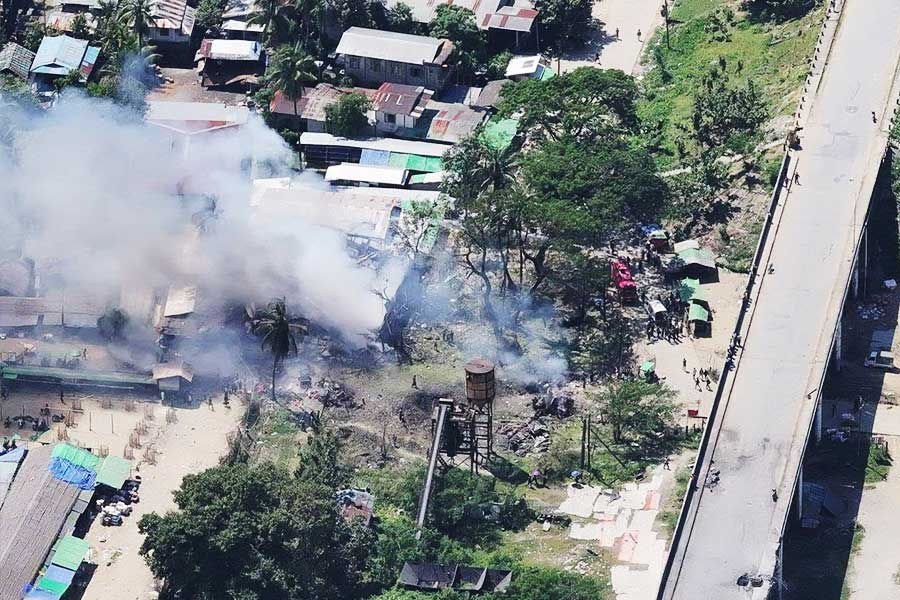
According to a statement released by the Karen National Union (KNU) on October 27, unprovoked airstrikes, heavy artillery shelling, and drone attacks by the military junta in Kyaikto Township, Thaton District, Mon State, resulted in eight civilian deaths and 11 injuries between October 9 and 15. A drone bomb attack inside Takwi Pu village resulted in the deaths of three family members.
Following the death of Deputy Tactical Operations Commander Lieutenant Colonel Zaw Myo Tint from the Ontaw-based Tank Battalion No. 72, who was captured by the Eagle Brother Guerrilla Force in Sagaing Township, Sagaing Region, the military junta’s forces launched columns and burned down 63 houses in Shwe Hlei village.
Out of approximately 2,000 residents and IDPs taking shelter in Setoktaya Township, Magway Region, and Kanpetlet Township, Chin State, over 300 patients are suffering from skin diseases, seasonal flu, and diarrhea, facing severe treatment difficulties due to a lack of medicines, according to the Chinland Liberation/Defense Army (CLLA).
An editorial letter addressed to the editor reported on corruption and evidence tampering by authorities and ward administration groups regarding a fire outbreak at a house in Kyike Thaw Myauk Village, Kawhmu Township, Twantay District, Yangon Region, which simultaneously held permissions for candle-making, palm oil, and fuel distribution businesses.
The Yangon Region Government announced that parking fees will be collected starting November 1 from 8:00 AM to 6:00 PM daily at 500 kyats per hour, covering eight zones including Strand Road up to Bogyoke Aung San Road through a tender system.
Border Impacts and Migrant Worker Issues
Heavy fighting broke out on the morning of October 29 near Min Let Pan village in southern Myawaddy Township between the military junta’s forces and the joint forces of the Karen National Liberation Army (KNLA), during which a stray heavy artillery shell injured a local Thai woman in Mae Sot District, Thailand.
The Myanmar Migrant Workers’ Rights Coordination Committee (MMWRCCT) urged the Thai government and employers to ease documentation rules, stating that Myanmar migrant workers are afraid of being forcibly conscripted if they return to border areas to renew their passports due to the military junta’s advance income tax collection and remittance proof requirements, and requested that visa and labor card fees be paid directly to the Thai government instead.
Thai authorities arrested 21 Myanmar workers lacking valid work permits and one Chinese supervisor at a warehouse construction site in Samut Sakhon Province on October 27.
Thai police are searching for two Myanmar married couples (two men and two women) accused of beating a Chinese employer and stabbing him to death following a wage dispute when they attempted to leave a Bangkok construction site without notice.
India’s Enforcement Directorate (ED) uncovered a “Drugs for Goods” modus operandi along the India-Myanmar border, where drug smuggling syndicates settle payments with Myanmar-based suppliers by purchasing and sending ordinary commodities such as petrol, diesel, wheat flour, edible oil, medicines, and clothing instead of cash.
Diplomacy, United Nations, and International Responses
During the UN General Assembly Third Committee meeting, Myanmar’s Permanent Representative to the United Nations, Ambassador Kyaw Moe Tun, shed tears while displaying a Theatre 21 cloth bearing the names and ages of individuals killed by the military junta. At the session, the EU rejected the military junta’s staged elections, while Russia and China defended the junta. UN experts presented that over 100,000 people have died in conflicts since the February 2021 takeover.
The ITALIA-BIRMANIA.INSIEME organization issued a statement on October 29 urging the Interpol President to reject the Myanmar military junta’s requests to issue Red Notices against CRPH, NUG, PDFs, opposition figures, and labor union members, and to ensure Interpol mechanisms are not misused.
Malaysian Prime Minister Anwar Ibrahim stated that despite facing international criticism for years over its approach to Myanmar’s refugee crisis, Malaysia chose a diplomatic pathway because previous decades of condemnation failed to change policies, leading to about 200,000 refugees seeking shelter and placing a burden on Malaysia, prompting him to invite and urge the military leadership to lower their stance during their meetings.
US Representative Frank Wolf delivered a keynote address at the 2026 Frank Wolf International Religious Freedom Awards ceremony hosted by 21WILBERFORCE in Falls Church, Virginia, highlighting the severe persecution of Christians by the Myanmar military junta.
International News and Geopolitics
US Secretary of Defense Pete Hegseth proposed creating a new, ambitious US-ASEAN defense framework prior to the ASEAN defense chiefs meeting in Cebu, aiming to navigate upcoming critical years while highlighting the need to maintain a “free and open Indo-Pacific” amid China’s growing regional influence.
Protests reminiscent of “The Hunger Games” dystopian film erupted in Jakarta and other Indonesian cities, with citizens displaying the three-finger salute and carrying banners denouncing economic hardships, corruption, widespread wildfires, and the declining popularity of President Prabowo Subianto.
Fistfights broke out between ruling Civil Contract party lawmakers and opposition Strong Armenia members inside the Armenian National Assembly on October 29, leaving some lawmakers injured following a heated verbal exchange over political involvements and proposals.
A magnitude 7 earthquake struck Baching County in Nagchu, Tibet, killing at least 16 people, injuring dozens, and destroying hundreds of homes.
Two high-speed trains collided in southern Madrid, Spain, resulting in 68 deaths and numerous injuries, marking one of Europe’s deadliest train accidents of the century.
A US-brokered local temporary truce in the Russian-occupied city of Oleshky in Ukraine’s Kherson region continues to hold as agreed.
Following Israel’s general election, both Prime Minister Benjamin Netanyahu and rival Gadi Eisenkot announced their respective intentions to form a new government as neither secured an outright majority.
In China, graduate youths face severe employment shortages amid tightening ideological controls under Xi Jinping, while the Thai cabinet approved a $375,900 Chinese funding agreement for green industrial and low-carbon economic projects.
Taiwanese gymnast Tang Chia-hung won the gold medal in the horizontal bar final at the 54th Artistic Gymnastics World Championships in Rotterdam, Netherlands, becoming Taiwan’s first-ever world champion in gymnastics.
Summary
Overall, while popular resistance and international diplomatic pressure against the military junta remain active during the Spring Revolution, the junta’s violent column operations have escalated civilian casualties and IDP crises domestically. Furthermore, border issues involving transnational drug networks, illegal migrant worker challenges, and regional war spillovers continue to pose significant challenges to neighboring security and stability.


Comments