
Sinicization of Myanmar’s Borderlands Spreads as MNDAA Erases Ta’ang Identity
- Apr 23
- 3 min read
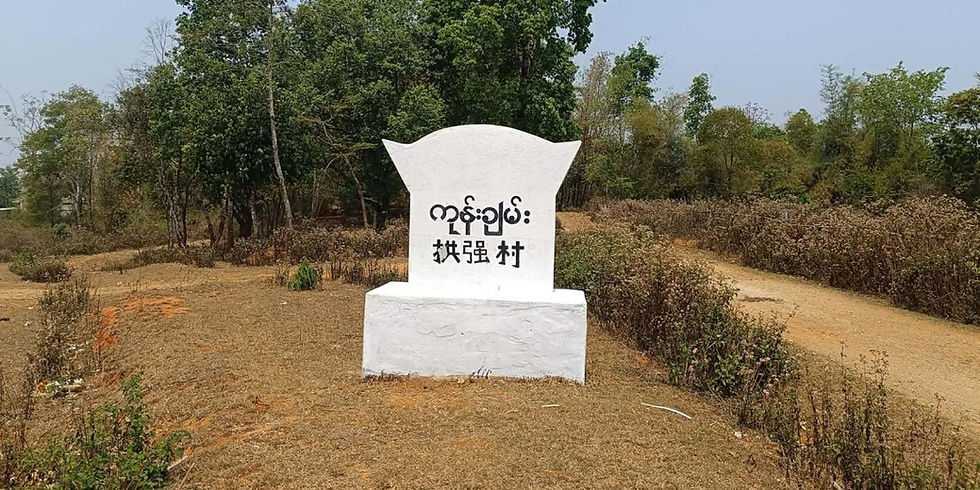
Locals in northern Shan State’s Kutkai Township say the Myanmar National Democratic Alliance Army (MNDAA) has replaced Ta’ang‑language signage with Chinese characters in more than a dozen villages, sparking fears of cultural erasure as the Chinese‑speaking armed group consolidates control of key border trade routes.
Residents told The Irrawaddy that MNDAA troops whitewashed Ta’ang‑language village signs—removing Ta’ang flag logos and text—and rewrote the village names in Chinese and Burmese. At least 10 villages in Kutkai have already had their signs altered.
“The MNDAA are forcing us to use Chinese without even consulting village committees. They act like they own the villages now. It’s painful to see our traditions erased, but we have no power to resist,” said a Ta’ang resident of Kutkai.
In early April, MNDAA officials summoned elders from more than 17 Ta’ang‑majority villages and banned them from displaying the Ta’ang national flag or using Ta’ang signage.
Kutkai, located on the Mandalay-Muse highway (AH14), fell to the MNDAA in March after clashes with its former Brotherhood Alliance ally, the Ta’ang National Liberation Army (TNLA). China, which successfully pressured both groups to halt offensives against the junta, has remained silent about the MNDAA’s attack on Kutkai. The assault came one day after Chinese envoy Deng Xijun met junta foreign minister Than Swe in Naypyitaw to discuss border cooperation.
Following the attack, TNLA spokeswoman Lway Yyay Oo told The Irrawaddy that the group urged the MNDAA to respect Ta’ang communities, identity and culture, and allow TNLA troops freedom of movement in Ta’ang areas.
Ta’ang civil society groups have condemned the MNDAA’s actions. The Ta’ang Civil Society Network (TCSN), representing six organizations, said replacing Ta’ang signs with Chinese amounted to erasing an ethnic identity—a violation of international human rights law.

“They are essentially destroying the cultural identity of an entire people. This breaches human rights and international norms. It also undermines the federal principle of peaceful coexistence among diverse ethnic groups and will only fuel further conflict. They must restore the original Ta’ang signs and symbols, and they owe the villagers an apology,” said TCSN spokesman Mai Karng Hao.
The MNDAA has also reportedly suspended more than 300 schools run by the Ta’ang Land Education Council and is preparing to introduce compulsory Chinese‑language lessons. The MNDAA was not available for comment.
The cultural shift in Kutkai mirrors the Sinicization of Hseni, a historic Shan town captured by the MNDAA during Operation 1027. Once the cultural heartland of the Shan saophas (feudal rulers), Hseni has been transformed so dramatically that many residents say they no longer recognize their own town. Since April 2025, the MNDAA has banned Shan‑ and English‑only signage, requiring all businesses to use Chinese as the primary language. The yuan is increasingly used in daily transactions.
Even the entrance to the Haw—the palace of Shan feudal rulers and a symbol of Shan identity—now bears a Chinese‑language sign. In official documents and MNDAA‑controlled media, the town’s name appears as “Mubang” (木邦), its Chinese equivalent.
Local media have reported an influx of Chinese business owners, while China‑backed banana, sugarcane and watermelon plantations continue to expand around the township. Meanwhile, local businesses have been pressured to add Chinese‑language signs.
An ethnic armed leader who recently visited northern Shan said Chinese signage and administrative practices are now visible in nearly all towns and villages the MNDAA captured during Operation 1027.
As the Kokang force extends its rule—from trade routes to village signboards—Ta’ang and Shan communities fear their cultural space is shrinking under an armed group heavily influenced by Beijing. The MNDAA now controls nearly all major trade corridors linking northern Shan to Yunnan Province—including the Chinshwehaw route seized during Operation 1027.


Comments