
Regime Continues Scorched-Earth Campaign Through Myanmar Heartland
- Apr 9
- 3 min read

The military regime continues its scorched-earth rampage through the Bamar heartland regions of Sagaing, Magwe and Mandalay, killing civilians and burning houses, even as it reconstitutes in pseudo-civilian garb in Naypyitaw.
The regime has stepped up offensives in resistance-held territories since December last year.
Sagaing
In upper Sagaing, regime troops captured the town of Tigyaing on March 30 before advancing in two columns on Indaw, another resistance-held town bordering Kachin State.
But resistance group Indaw Revolution told local media that the columns failed to make it through its defences and were pushed back to Tigyaing.
Sitting at the junction of the regime’s central, northwestern and northern commands, Tigyaing frees up a crucial logistical node for the regime as it battles heartland resistance groups and the Kachin Independence Army (KIA) in Katha and Kawlin in Sagaing and Bhamo in Kachin State.
Over the last few weeks, civilians were reported killed and abducted, hundreds of houses burned, and thousands displaced in regime offensives in the Sagaing townships of Ayadaw, Chaung-U, Wetlet and Yinmabin.
On March 22, the resistance Burma Liberation Democratic Front (BLDF) reported that regime raiders torched over 150 houses in the village of Shantu in Chaung-U Township.
Magwe
Magwe also faces increasing offensives, especially on the western bank of the Irrawaddy River, which comprises the districts of Gangaw, Pakokku and Minbu. While the regime now mostly controls the towns here, much of the countryside remains under the control of resistance groups.
“With strongholds inside the towns, the regime force can now carry out military offensives in wider areas”, an analyst from Magwe told The Irrawaddy. “But they mostly dash out for quick raids and then retreat to the towns because they daren’t stay long in the villages”.
The regime’s growing successes in the heartland are due to availability of troops thanks to increased subscription and truces with rebel ethnic groups in Shan State, air support—and disunity among local resistance groups.
According to local media reports, the regime has launched offensives in the Magwe townships of Chauk, Minbu, Ngape, Salin and Myaing over the last three weeks, where its troops repeatedly clashed with or were ambushed by resistance groups. Regime forces carried out arson attacks and looted civilians’ properties.
In the last week of March, a regime raid on four villages in Chauk resulted in the burning of over 250 houses, displacing thousands of villagers, while some were taken hostage as human shields, local media reported.
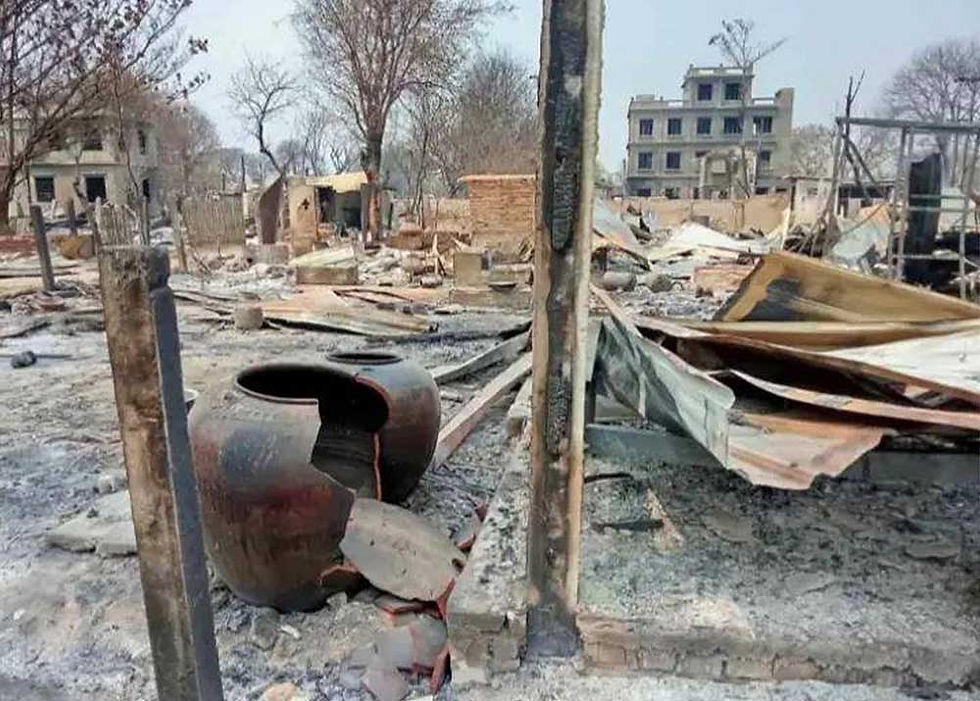
n Mandalay Region, Myingyan District has borne the brunt of regime offensives.
During a raid in Myingyan’s Petbingaing village on April 2, regime forces burned over 300 houses to ashes and killed six civilians, including a mother and her a 18-month-old child.
From March 22 to 28, military operations along the Myingyan–Tada U road burned down over 700 houses, displacing thousands of civilians.
In Taung Tha Township, two villagers were killed and houses destroyed as regime forces torched a trail from March 20 to 26, according to local media.
The regime is using close air support as cover and to clear the way ahead for advancing troops.
In Kyaukpaduang, over 200 houses were burned down in regime attacks, killing several villagers including an elderly person. A young girl was reported to have been gang-raped by marauding regime troops before being killed.
Raiding columns consist of around 100 soldiers each plus air support, according to a defector. The regime also increasingly relies on multiple fighter jets in attacks on a single target in resistance-controlled areas, resulting in mass casualties of civilians.
The attacks continue despite the military regime’s attempts to establish itself as a civilian government with junta boss-turned-president Min Aung Hlaing at its head.
Commenting on the ostensible transition on Saturday, ASEAN chair the Philippines urged the regime to fully implement the bloc’s Five-Point Consensus, saying Manila “hopes to see an end to violence and unhindered delivery of humanitarian assistance”—but so far to no avail.


Comments