
Oil Pipeline in Kyaukphyu, Rakhine State Is Completed
On This Day in Arakan History ၊ October 30, 2014
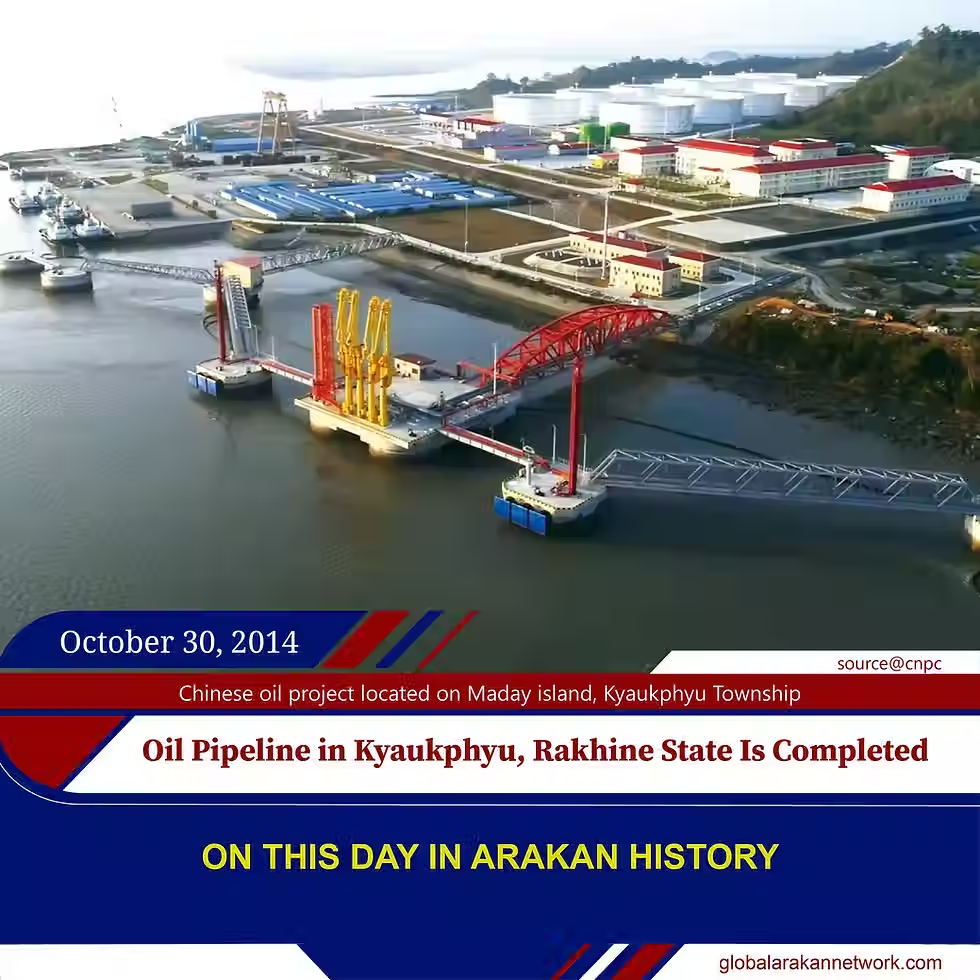
October 30, 2014, marks the completion date of the Sino-Myanmar crude oil pipeline, a massive infrastructure project running 771 kilometers from Kyaukphyu Port in Rakhine State to Kunming in China's Yunnan province.
The pipeline, jointly invested by China National Petroleum Corporation (CNPC) with 50.9% ownership and Myanmar's state-run Oil and Gas Enterprise (MOGE) with 49.1%, was designed to transmit 22 million tons of crude oil annually.
Construction had begun in June 2010 and was physically completed on May 30, 2014 . By October 30, the project reached a key milestone with the ceremonial opening of Maday Island Port—the pipeline's starting point—where the first 300,000-ton capacity oil tanker was already in place.
For Rakhine State, this completion represented both the promise of economic development and the reality of land confiscation and inadequate compensation for affected communities. In addition, Myanmar’s central government failed to share a fair proportion of the revenue with the local Rakhine people, resulting in negative sentiments towards these investments. One source claimed that the central government received between USD 160 million and USD 320 million in transit fees from the oil pipelines.

The pipeline's completion was historically significant because it represented the final piece of Myanmar's largest-ever energy infrastructure project, complementing the natural gas pipeline that had begun operations in October 2013.
Together, these pipelines formed a strategic energy corridor giving China overland access to Middle Eastern oil, bypassing the Malacca Strait through which nearly 80% of its oil imports previously passed.
However, the project was deeply controversial from the outset. On Made Island alone, 114 acres belonging to 30 farmers were reportedly seized without compensation, with only cultivated land compensated while plots used for firewood were deemed "vacant".

The Shwe Gas Movement had earlier highlighted "glaring weaknesses" in Myanmar's legal framework regarding extractive industries, warning of "human rights abuses, environmental damage and poor revenue distribution" . Despite its physical completion in 2014, the pipeline would not begin actual operations until April 2017 after lengthy negotiations over transit fees.
The October 2014 completion set in motion lasting consequences for Rakhine State and Myanmar-China relations. First, it created enduring grievances among affected communities due to the lack of profit-sharing by the central government in Naypyidaw. In March 2018, approximately 600 people in Rakhine State marched to demand compensation for land seized for the pipeline, with protest leader Zaw Win Lay stating: "Because of this gas pipeline, many villagers lost their land, and central government hasn’t taken any responsibility for it".
Second, the project became a template for Chinese Belt and Road Initiative investments in Myanmar, demonstrating both potential benefits and the risks of large-scale infrastructure in conflict-affected regions.
Third, the pipeline's strategic importance to China would later complicate international responses to Myanmar's crises, including the 2021 military coup.
Fourth, following the resumption of armed conflict in November 2023, the Arakan Army expanded its territorial control over Rakhine State, including areas through which the China–Myanmar oil and gas pipelines pass. This development introduced a new security dimension to the project, as the Myanmar military government was no longer the only actor with significant influence over the security environment along the pipeline routes. Meanwhile, the United League of Arakan (ULA) has pledged to safeguard Chinese investments and personnel in areas under its administration.
The October 30, 2014 completion thus stands as a moment when Rakhine State became permanently integrated into regional energy geopolitics, with consequences that continue to unfold.

Comments