
Myanmar Junta’s Rakhine Offensive Kills Over 70 Civilians but Makes No Territorial Gains: ISP-Myanmar
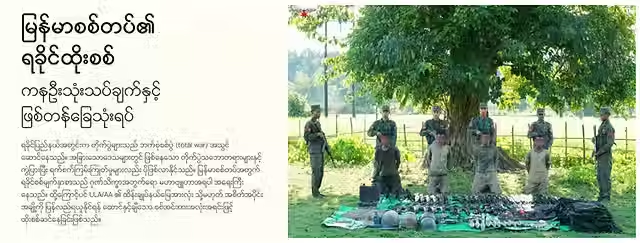
Myanmar’s military has launched one of its largest coordinated offensives against the United League of Arakan/Arakan Army (ULA/AA) in recent months, deploying around 2,000 troops across multiple fronts and combining ground, naval and air attacks. Yet, according to a new assessment by the Institute for Strategy and Policy–Myanmar (ISP-Myanmar), the offensive has so far failed to produce any tangible territorial gains while causing more than 70 civilian deaths.
The offensive began in early September and has affected not only Rakhine State but also neighboring areas of Magway, Bago and Ayeyarwady regions. Fighting has intensified around Kyaukphyu, Sittwe and Ponnagyun, as well as several areas along the borders of Rakhine State.
Although the Myanmar military has not officially announced an operation under the name “Operation 4926” or “Operation Yan Naing Aung,” military supporters have used those names to describe the campaign.
The scale of the operation indicates that the junta considers the Rakhine battlefield strategically important. The military has spent months preparing for the offensive, reinforcing coastal naval bases, military facilities and strategic positions while increasing artillery and air attacks.
ISP-Myanmar divides the military campaign into three broad stages: preparation, preliminary operations and the current escalation.
Since late 2025, the junta has reportedly strengthened its forces around key military and industrial locations, including defense equipment factories and naval bases. Troops from several regional military commands and divisions have reportedly been brought into the Rakhine theater. At least 10 military vessels were also reported to be operating near Sittwe, Ramree, Thandwe and Gwa.
The military then expanded its preliminary operations during 2026, including attempts to conduct amphibious operations around Kyaukphyu, Thandwe, Taungup and Gwa. It also launched offensives in southern Chin State, apparently seeking to pressure ULA/AA positions from multiple directions.
Since September 4, the campaign has entered a more intensive phase. Seven military columns have reportedly advanced along different routes, supported by naval artillery and airstrikes. ULA/AA forces have responded with defensive operations and localized counterattacks, while both sides have made extensive use of FPV drones.
A costly offensive without territorial results
The most important finding in the ISP-Myanmar assessment is that, despite the scale of the operation, ULA/AA has not yet suffered any significant territorial loss.
This is particularly significant because the junta is employing combined ground, naval and air power. The military appears to be attempting to recover territory lost during the rapid ULA/AA offensives of the past two years, rather than simply defending its remaining positions.
The battlefield therefore represents a fundamentally different type of conflict from the lower-intensity guerrilla warfare seen in some other parts of Myanmar. ULA/AA is fighting to capture and hold towns, military positions and territory, while the junta is attempting to recover lost territory through coordinated ground, naval and air operations.
The comparison with previous large-scale Myanmar military offensives against the KNU and MNDAA also highlights the strategic importance of the current campaign.
However, the absence of territorial gains so far raises questions about whether the junta possesses sufficient manpower and combat capacity to reverse ULA/AA's territorial advances.
The military is already required to maintain major deployments on several other fronts, including Kachin State and Karen State. This makes it difficult to rapidly send enough additional forces to Rakhine State to produce a decisive change on the battlefield.
Civilians are paying the highest price
While the military has yet to regain territory, civilians have already suffered heavily.
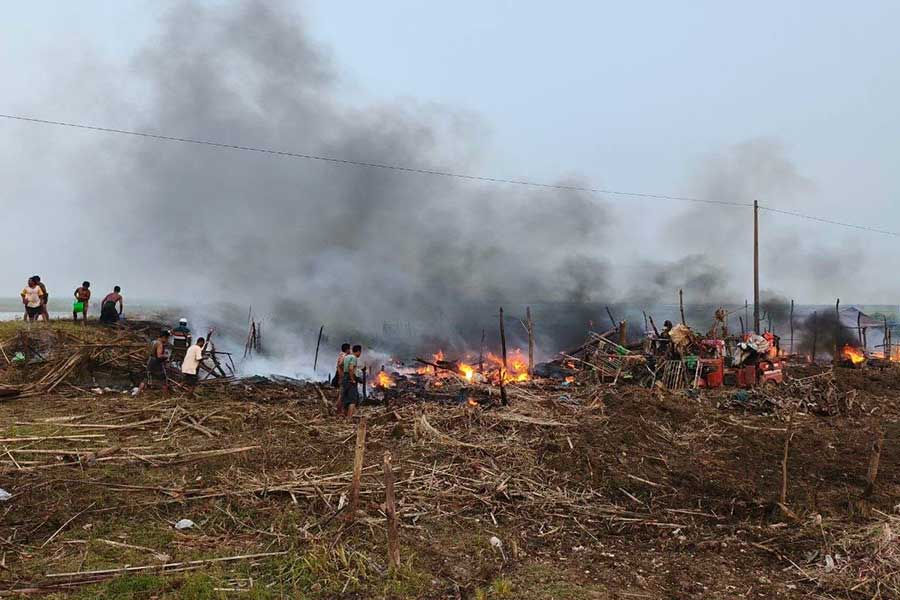
According to ISP-Myanmar, more than 70 civilians have been killed since September 4 as a result of air and artillery attacks. More than 6,000 people from around 24 villages in Kyaukphyu, Sittwe, Ponnagyun and Rathedaung townships have also been displaced.
These figures demonstrate the humanitarian consequences of an offensive increasingly characterized by the combined use of heavy artillery, naval fire and air power.
The danger is particularly serious because the junta has demonstrated its willingness to use air power and long-range firepower in areas where civilians remain present. As the ground offensive encounters resistance, the military could increasingly rely on airstrikes and artillery to compensate for difficulties in advancing on the ground.
Comments