
Myanmar: From a Mirrorless Cell
- Apr 27
- 2 min read
Insight Myanmar
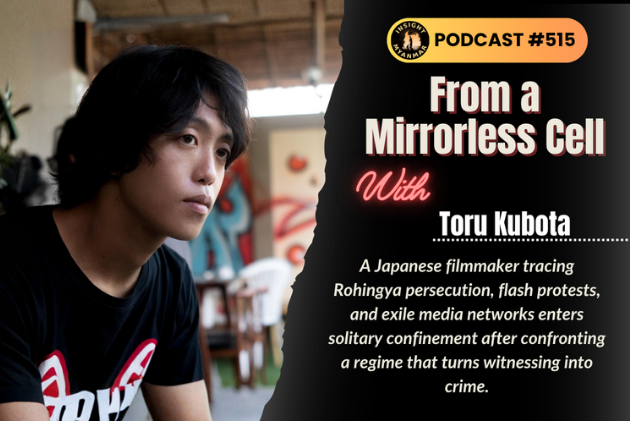
Toru Kubota is a Japanese documentary filmmaker who argues that storytelling can cultivate empathy in ways argument alone cannot. Reflecting on his work, he says, “You never know, but you have to imagine, and you have to trying to feel the others.” That principle shapes his journey from a political science student in Japan to a political prisoner in Myanmar and, after his release, to an advocate supporting exiled Burmese filmmakers along the Thai–Myanmar border.
Kubota was born in Yokohama and studied political science at Keio University. He jokes how becoming a filmmaker was “pure coincidence.” As a student in 2014, he joined a university project interviewing Rohingya refugees living in Gunma Prefecture. Japan’s refugee recognition rate was extremely low, and the project sought to understand how Rohingya families were trying to build lives in Japanese society. During that work, he began using a camera for the first time, and the team produced a short documentary about Rohingya life in Japan and screened it for members of the community. During the project work, some told him that unless he went to Myanmar himself, he would not be able to understand what was happening there.
That response prompted his first trip, in August 2015, just before Myanmar’s general election. He stayed mostly in Yangon and also visited some tourist spots; he observed a society that, at least on the surface, appeared to be opening and hopeful about democratic reform. The trip enabled him to dip his toe in the water, and prepare to return in a more focused way.
The following year, Kubota traveled to Sittwe in Rakhine State, where camps had been set up to house Rohingya that had been displaced after the violence in 2012. Although these were officially designated as “internally displaced persons” (IDP) camps, he describes them more as internment camps, where Rohingya Muslims were segregated from surrounding Buddhist communities and confined with limited access to medical care and food. While inside one camp, he witnessed an accidental fire, and filmed as children ran back and forth with water, attempting to extinguish flames that continued to spread. When he later brought the footage back to Japan and began editing, he realized he had captured a powerful moment, and created a 20-minute film from it. This experience marked a turning point. He began to see filmmaking not merely as a form of “objective” documentation, but as a way to convey the subjects’ lived reality.


Comments