
Making Sense of Recent Report by the Guardian on Arakan Army
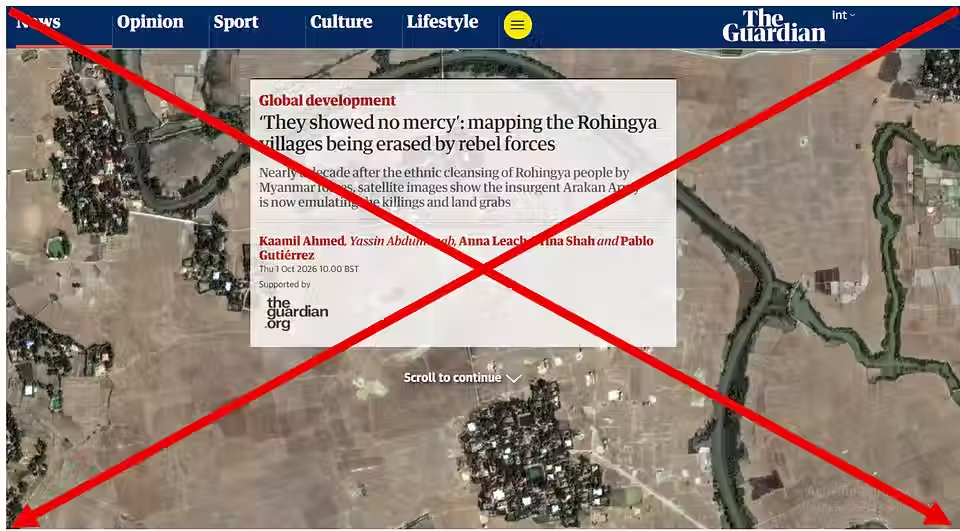
On October 1, 2026, The Guardian published a report about the actions of the Arakan Army (AA) in Buthidaung township in northern Arakan. The report focused mainly on three locations: the new Htan Shauk Khan village near Hnget Thay village, Ywet Nyo Taung village, and U Hla Phay village. Based on satellite images, field information and testimonies, the report presented serious allegations against the AA, including burning villages, displacing residents, using forced labour and occupying village locations for military purposes.

Villages mentioned in the Guardian report
However, the picture presented by the report does not fully explain what happened on the ground. The situation in northern Arakan must be understood in the context of intense armed conflict between the AA and the Myanmar junta, with Muslim militant groups such as ARSA, RSO and ARA also involved in the fighting.
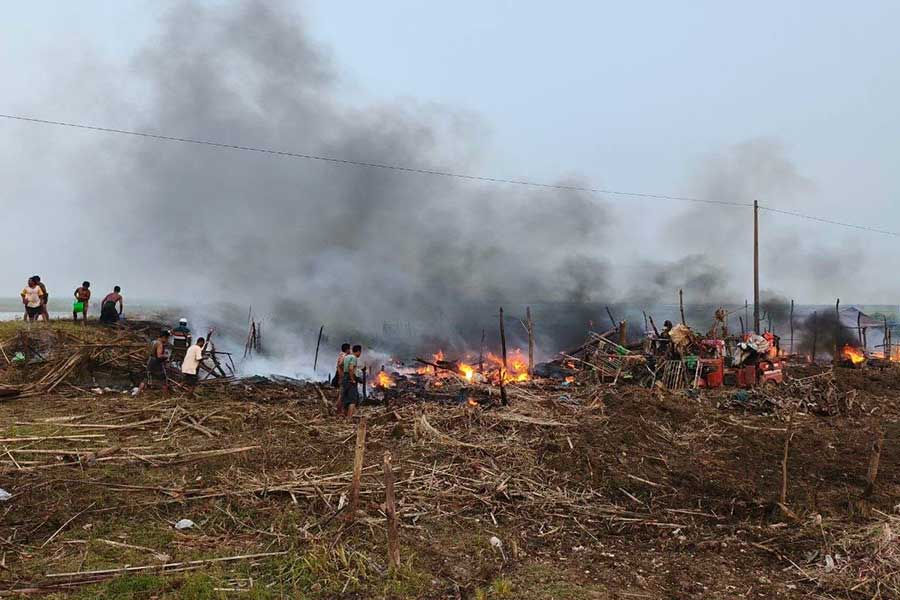
During these battles, Muslim militants often attacked from village areas against the AA, while the Myanmar military provided aerial and artillery support. Heavy fighting and military attacks resulted in the destruction and burning of many villages and homes. Therefore, the three locations highlighted by The Guardian cannot simply be presented as evidence of deliberate destruction by the AA without considering the wider battlefield context.
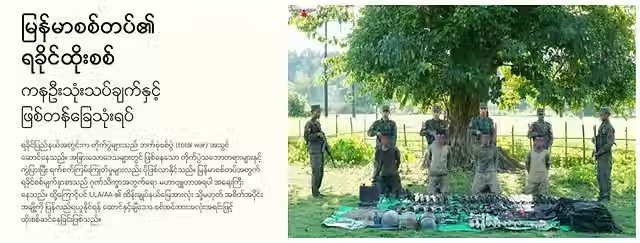
The case of Htan Shauk Khan is particularly important. The ULA and its humanitarian wing, HDCO, have already provided an account of what happened during the fighting and how displaced villagers were relocated to a new village. This location should not automatically be described as a detention camp.
According to the HDCO account, the village was managed by Muslim administrators themselves. The relocation should therefore be examined in the context of displacement caused by armed conflict rather than being presented only as a policy of detention or forced displacement by the AA.

The same context applies to Ywet Nyo Taung and U Hla Phay. Reports during the fighting indicated that these villages were burned and that residents were displaced to nearby areas because of the armed clashes. There is also a serious security problem in returning to locations that were occupied or used by armed militant groups. Mines and unexploded explosives can remain hidden in abandoned villages, making immediate resettlement dangerous.
This is not a situation unique to Muslim communities. Hundreds of Rakhine and other minority villages have also been destroyed or abandoned during the conflict, particularly since 2019. Many displaced Rakhine villagers have been unable to return because of destroyed homes, ongoing insecurity, mines and unexploded explosives. If these two situations are similar, they should be examined with the same standard rather than through different political assumptions.

The final and most sensitive issue is the claim that the AA has used these village locations to establish military sites and camps. Satellite images and oral testimony alone may not be enough to establish the full ground reality. The possibility should be investigated, but it should not automatically be treated as a proven fact.
It is also possible that ULA officials, together with Muslim community leaders and local administrators, arranged for Muslim members of the AA to be stationed in some areas to perform law-and-order duties. If so, this would be very different from the simple picture of an AA military occupation presented in the report.

The key point is not that every allegation should be dismissed. Rather, serious allegations require serious evidence and proper context. Northern Arakan is one of the most complicated conflict zones in Myanmar. Villages have changed hands, populations have been displaced, armed groups have operated inside civilian areas, and military attacks have destroyed homes and communities. In such an environment, satellite images and individual testimonies can provide important clues, but they do not always explain the full story.
Therefore, The Guardian report should be read carefully rather than accepted as the complete account of what happened. A rushed conclusion based on incomplete information can deepen misunderstanding in an already deeply divided society. When reporting on controversial incidents in northern Arakan, careful investigation, local context and equal standards are essential.
Comments