
How Power Really Works in Myanmar

When Myanmar’s military-backed Union Solidarity and Development Party gathered in Naypyitaw for its fourth party congress in September 2026, much of the attention focused on whether Khin Yi would survive as chairman. For weeks, reports had suggested that President Min Aung Hlaing wanted to reshape the party leadership and move trusted associates into senior positions. Khin Yi’s reelection was therefore quickly interpreted by some observers as evidence that he had resisted the president and emerged as an independent political force.
The tension was real. The conclusion was overstated.
Myanmar’s post-election system has become more institutionally differentiated. Min Aung Hlaing is now president rather than commander-in-chief. General Ye Win Oo formally commands the armed forces. Khin Yi leads the USDP and serves as speaker of the Lower House. Each controls an important part of the political system, and each has room to pursue institutional interests within his own domain.
Yet these three men do not occupy equivalent positions. Min Aung Hlaing’s authority extends far beyond the constitutional powers of the presidency because it rests on 15 years at the top of the military, the senior officers promoted during his tenure, the political system he constructed after the 2021 coup, and his accumulated influence across the military and state bureaucracy. Ye Win Oo possesses genuine command authority, but he inherited a military hierarchy largely shaped under Min Aung Hlaing. Khin Yi has meaningful bargaining power inside the USDP and parliament, but his institutional base remains concentrated in party politics.
The emerging order is therefore best understood as a hierarchy in which authority has become more specialized without becoming equally distributed.
Min Aung Hlaing: Authority beyond office

Min Aung Hlaing’s political position cannot be measured simply by the formal powers of the presidency. By the time he entered that office in 2026, he had already spent 15 years as commander-in-chief and five years as the central political authority of the post-coup government.
Between 2011 and 2026, successive generations of regional commanders, general staff officers, military-security officials and senior generals advanced through a personnel system over which Min Aung Hlaing exercised decisive influence. Promotion in the Myanmar military depends heavily on appointments, transfers, command experience, seniority and access to the highest leadership. A commander who remains at the apex of that system for 15 years therefore accumulates relationships that survive the formal transfer of office.
The period after the 2021 coup broadened that authority. Min Aung Hlaing became the principal decision maker of the military government, oversaw appointments across the state, managed the relationship between the armed forces and the civilian bureaucracy, and shaped the political transition that produced the current constitutional arrangement. His election as president placed an existing political authority inside the country’s highest civilian office.
Myanmar has a historical precedent for this distinction between formal office and political standing. Ne Win gave up the presidency in 1981 while retaining his position as chairman of the Burma Socialist Programme Party. Other figures occupied the presidency and senior military posts, yet Ne Win remained the central figure in the ruling order for years because his authority had accumulated through decades of military leadership, personnel management, and control over the political system.
Contemporary Myanmar operates under very different conditions, but the underlying political logic remains relevant. A leader who has spent years controlling promotions, appointments, and elite relationships does not necessarily lose his position within the hierarchy when he moves from one formal office to another.
Min Aung Hlaing’s transition from commander-in chief to president therefore changed the mechanism through which he exercises authority more than its overall political scope. He no longer issues the military’s daily orders. He does not personally manage the USDP’s organizational affairs. Ministers, parliamentary leaders and commanders now possess greater responsibility inside their own institutions. His position rests increasingly on his capacity to coordinate those institutions, determine senior appointments and arbitrate disputes among them.
This gives Myanmar’s new system a distinctive structure: more officials exercise substantial authority, while the political hierarchy continues to converge at the top.
Ye Win Oo: Command without a second political center
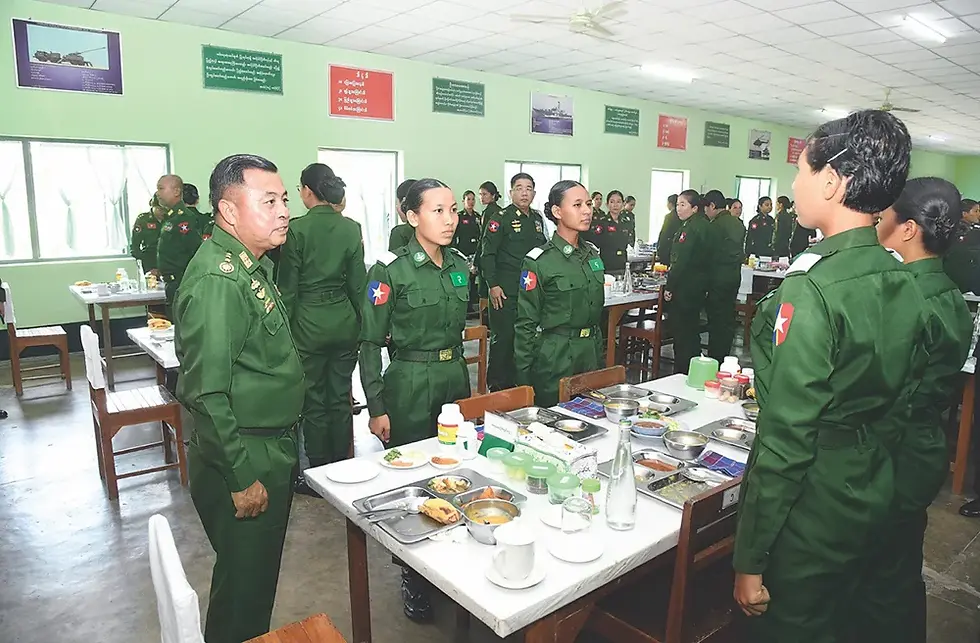
The appointment of General Ye Win Oo as commander-in-chief is the clearest example of this new division of functions.
The office itself carries enormous institutional power. Ye Win Oo commands the armed forces, works directly with regional commanders, sits at the top of the military chain of command and exercises influence over promotions and assignments. Military operations, force management and the professional interests of the armed forces now fall under his direct authority.
This is genuine power, and it should not be reduced to a ceremonial delegation. Effective military command requires discretion. Min Aung Hlaing could not transfer the office while continuing to personally manage every military decision from the presidency.
At the same time, Ye Win Oo assumed command inside a hierarchy created largely during Min Aung Hlaing’s tenure. Much of the senior officer corps reached its present position during the previous commander’s 15 years in office. Ye Win Oo himself rose through military security and other senior positions within that same personnel system before being selected as successor.
The March 2026 handover therefore separated formal military command from overall political leadership without immediately creating two competing centers of authority.
This distinction is particularly important in the military. Myanmar’s armed forces have historically maintained a strong internal hierarchy based on rank, seniority, military education, command experience and centrally controlled appointments. Regional commanders can exercise considerable operational authority, but promotion and transfer remain dependent on the center. Senior officers move between field commands, general staff positions, security institutions and administrative posts, making their careers closely tied to the military leadership as a whole.
Competition exists within this structure. Officers compete over commands, promotion, resources and access to senior leaders. What matters politically is whether those networks develop into an independent chain of authority capable of operating across the military and political systems.
There is little evidence that Ye Win Oo has reached that position. His current significance comes from controlling one of the most powerful institutions in Myanmar, while his political authority remains embedded in a broader hierarchy that Min Aung Hlaing helped construct.
Over time, this relationship could evolve. Any commander-in-chief who controls appointments and works closely with senior officers will gradually develop institutional relationships of his own. For now, however, Ye Win Oo represents the transfer of operational military authority within the existing order rather than the emergence of an alternative political apex.
Khin Yi: Party autonomy within the hierarchy

Khin Yi occupies a different position. His authority comes from the USDP and parliament rather than the armed forces.
His reelection as party chairman in September was politically meaningful. The USDP now dominates the post-election parliament, manages the careers of legislators and party officials, and has its own organizational interests. Khin Yi also serves as speaker of the Lower House. These positions give him considerably more institutional weight than he possessed when he first became party chairman in 2022.
The USDP therefore cannot be treated simply as an administrative extension of the presidency. Its senior officials have careers to protect, regional organizations to manage, and expectations about how appointments should be distributed. Established party cadres have incentives to resist the rapid insertion of retired officers if such appointments threaten existing promotion channels or reduce the authority of the party organization.
This helps explain the reported disagreements surrounding the September congress. Khin Yi had reasons to preserve the existing party hierarchy, while Min Aung Hlaing had reasons to ensure that the USDP remained politically reliable and compatible with the wider governing structure. Disputes over senior party positions, retired officers and the distribution of government and parliamentary posts can therefore be substantive without becoming a struggle over supreme authority.
Khin Yi’s reelection demonstrated the USDP’s organizational weight. It showed that the party leadership could defend established interests and that political personnel decisions required bargaining. It did not establish that Khin Yi commands resources comparable to those accumulated by Min Aung Hlaing.
The difference lies in the character of their respective power bases. Khin Yi’s leverage is concentrated in the party, parliament and political appointments. He does not control military commands, the military-security system, or the promotion structure of the armed forces. His capacity to bargain inside the political system is therefore considerable, while his ability to reshape the overall hierarchy remains more limited.
Min Aung Hlaing’s formal entry into the USDP after the congress further complicates their relationship. The president now sits inside the same party organization that Khin Yi chairs. This creates additional room for negotiation over leadership positions and government-party relations, while extending Min Aung Hlaing’s institutional presence into the ruling party itself.
The resulting relationship is likely to generate recurring friction. Khin Yi will seek to preserve the autonomy and interests of the party organization. Min Aung Hlaing will seek to maintain the compatibility of the USDP with the broader political structure. Individual personnel disputes may therefore become sharper as the post-election system matures.
Such disputes are evidence of institutional politics inside the ruling establishment. They provide much less evidence of a divided political apex.
Myanmar’s new political order can consequently be understood through these three figures. Ye Win Oo commands the military. Khin Yi manages the ruling party and presides over the lower house. Both exercise significant authority within clearly defined institutional fields. Min Aung Hlaing occupies a broader position because his authority was accumulated before the current distribution of offices and continues to connect the military, presidency, party, and state bureaucracy.
The main change since 2026 is therefore the distribution of functions. The military, presidency, parliament and USDP now have more clearly differentiated leadership than during the State Administration Council period, when Min Aung Hlaing directly combined the highest political and military offices.
That arrangement will produce more bargaining, more institutional interests and more visible disagreements among senior figures. The decisive indicator of a deeper redistribution of power would be a change in who controls senior appointments, who can build political and coercive networks across institutional boundaries, and who ultimately arbitrates conflicts between the military, party, parliament and government.
For now, the evidence points to a system with three important centers of institutional responsibility but one overriding political authority. Min Aung Hlaing remains at the apex; Ye Win Oo and Khin Yi exercise substantial power within the military and political domains beneath him.
Liu Yun is a China-based independent analyst.


Comments